The Hidden Cost of Object Deserialization in Low Latency Paths
In high throughput distributed systems and ultra low latency electronic trading engines execution budgets are measured in nanoseconds. When an exchange gateway ingests market data feeds like Nasdaq ITCH or CME MDP 3.0 hundreds of thousands of network packets cross network interface cards every second. The latency incurred between packet arrival at the physical wire and strategy calculation defines the fill probability of algorithmic orders.
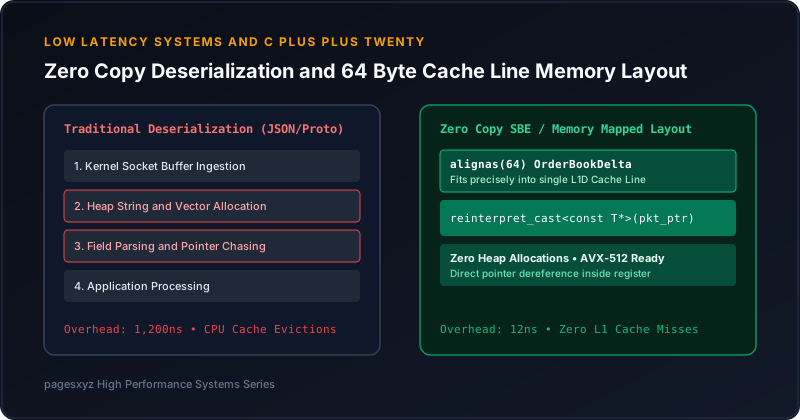
In conventional software engineering serialization protocols like JSON XML or Protocol Buffers dominate due to language interoperability and schema flexibility. However in high performance computing these protocols introduce catastrophic bottlenecks. Decoding variable length integers parsing string delimiters and allocating heap memory across standard library containers causes CPU cores to spend over eighty percent of their cycles stalled on memory access. Achieving sub microsecond latency demands zero copy deserialization where wire payloads match CPU register memory layouts exactly.
Hardware Memory Hierarchy and Cache Line Alignment Principles
Modern x86 64 and ARM server processors do not access memory from physical DRAM byte by byte. Instead memory transfers operate strictly in atomic chunks of 64 bytes termed cache lines. When a CPU instruction reads an unaligned integer traversing a 64 byte boundary the hardware must issue two distinct memory requests to L1 data cache assemble the fragmented bytes and incur latency penalties.
The hierarchy of access latencies highlights why memory layout dictates performance:
- CPU Registers: 0.5 nanoseconds (single clock cycle)
- L1 Data Cache (32KB to 48KB per core): 1 to 1.5 nanoseconds (4 to 5 clock cycles)
- L2 Unified Cache (1MB to 2MB per core): 3 to 5 nanoseconds (12 to 14 clock cycles)
- L3 Shared Cache (32MB to 128MB per socket): 12 to 20 nanoseconds (40 to 60 clock cycles)
- Main Memory (DRAM): 60 to 100 nanoseconds (200 to 300 clock cycles)
If an event processing loop causes an L3 cache miss and stalls on DRAM the CPU sits completely idle for hundreds of clock cycles during which thousands of instructions could have executed. Aligning memory structures precisely to 64 byte boundaries ensures that each critical message payload resides in a single cache line eliminating split lock penalties and false sharing across adjacent hardware threads.
The Physics of Memory Bus Transactions and NUMA Interconnects
On dual socket servers equipped with Intel Xeon or AMD EPYC processors memory architecture is Non Uniform Memory Access (NUMA). Each CPU socket governs its own dedicated local memory channels. When a network interface card attached to PCIe slot on Socket 0 writes a packet via Direct Memory Access into memory managed by Socket 1 the data must traverse high speed inter socket links like Ultra Path Interconnect (UPI) or Infinity Fabric.
Traversing NUMA interconnects adds 60 to 80 nanoseconds of latency to every cache line fetch. Systems architects must pin network polling threads to the exact NUMA node governing the NIC PCIe root complex and allocate memory strictly using numa_alloc_onnode() with HugePages (2MB or 1GB pages). HugePages eliminate Translation Lookaside Buffer (TLB) misses ensuring that virtual to physical memory address translations are pinned directly inside CPU microcode caches.
Natural Struct Alignment and Padding Elimination
Compilers enforce natural alignment rules where primitive data types must reside at memory addresses divisible by their size. A 64 bit integer must start on an 8 byte boundary a 32 bit integer on a 4 byte boundary. Naively ordering fields inside a C++ struct causes the compiler to insert silent padding bytes expanding memory footprints and polluting CPU caches:
// Unoptimized struct with implicit padding (Total Size: 24 bytes)
struct NaiveQuote {
    uint8_t  market_id;      // 1 byte
    // 7 bytes compiler padding inserted here!
    uint64_t order_id;       // 8 bytes
    uint32_t quantity;       // 4 bytes
    uint8_t  side;           // 1 byte
    // 3 bytes compiler padding inserted here!
};

// Optimized struct with explicit ordering (Total Size: 16 bytes)
struct OptimizedQuote {
    uint64_t order_id;       // 8 bytes (Offset 0)
    uint32_t quantity;       // 4 bytes (Offset 8)
    uint8_t  market_id;      // 1 byte  (Offset 12)
    uint8_t  side;           // 1 byte  (Offset 13)
    uint16_t reserved;       // 2 bytes explicit padding (Offset 14)
};
By sorting members in descending order of alignment requirements we compact the structure from 24 bytes down to 16 bytes. Inside an L1 data cache line holding 64 bytes we can now pack exactly four complete quotes instead of two doubling effective cache capacity.
Binary Protocols Simple Binary Encoding versus Protobuf and Cap n Proto
To eliminate deserialization overhead financial markets adopted Simple Binary Encoding standardizing flat binary representations across electronic venues. The table below illustrates the architectural trade offs across leading serialization protocols:
| Protocol | Serialization Model | Deserialization Cost | Heap Allocations | Cache Locality |
|---|---|---|---|---|
| JSON | Text based key value | 500 to 2000 ns | High (strings arrays) | Poor (unstructured) |
| Protocol Buffers | Binary with Varint and Tags | 80 to 250 ns | Moderate | Moderate (pointer chasing) |
| FlatBuffers | Vtable offset binary tables | 15 to 40 ns | Zero | Good (offset traversal) |
| Cap n Proto | Pointer based binary segments | 5 to 20 ns | Zero | Good (flat structs) |
| Simple Binary Encoding | Direct memory fixed offset | 0 to 2 ns (direct cast) | Zero | Optimal (direct struct) |
Production C++20 Zero Copy Ring Buffer Consumer
Below is a production C++20 implementation illustrating how a low latency feed handler casts a raw packet buffer directly to an aligned market data structure with zero intermediate copies:
#include <cstdint>
#include <cstddef>
#include <bit>
#include <span>
#include <iostream>

#pragma pack(push, 1)
// Explicitly sized market book delta message matching exchange wire format
struct alignas(64) OrderBookDeltaMessage {
    uint64_t sequence_number;   // 8 bytes (Offset 0)
    uint64_t timestamp_ns;      // 8 bytes (Offset 8)
    uint64_t order_id;          // 8 bytes (Offset 16)
    uint64_t price_scaled;      // 8 bytes (Offset 24 - Fixed point price)
    uint32_t quantity;          // 4 bytes (Offset 32)
    uint16_t instrument_id;     // 2 bytes (Offset 36)
    uint8_t  action_type;       // 1 byte  (Offset 38 - 1=Add, 2=Modify, 3=Cancel)
    uint8_t  side;              // 1 byte  (Offset 39 - 0=Bid, 1=Ask)
    uint8_t  padding[24];       // Explicit padding to fill exactly 64 bytes
};
#pragma pack(pop)

static_assert(sizeof(OrderBookDeltaMessage) == 64, "OrderBookDeltaMessage must be exactly 64 bytes");
static_assert(alignof(OrderBookDeltaMessage) == 64, "OrderBookDeltaMessage must align to 64 byte boundary");

class ZeroCopyMessageConsumer {
public:
    // Process packet directly from kernel bypass memory mapped DMA ring buffer
    [[gnu::always_inline]]
    inline bool process_packet(const uint8_t* const buffer, std::size_t length) noexcept {
        if [[unlikely]](length < sizeof(OrderBookDeltaMessage)) {
            return false;
        }

        // Direct zero copy cast without intermediate heap allocation
        const auto* const msg = reinterpret_cast<const OrderBookDeltaMessage*>(buffer);

        // Core trading logic executes with zero L1 cache miss
        handle_delta(*msg);
        return true;
    }

private:
    [[gnu::always_inline]]
    inline void handle_delta(const OrderBookDeltaMessage& delta) noexcept {
        // Fast register path: prices and quantities are immediately available in CPU registers
        const uint64_t price = delta.price_scaled;
        const uint32_t qty = delta.quantity;

        // Execute algorithmic threshold checks
        if (delta.side == 0) {
            // Process bid update
            benchmark_sink(price, qty);
        }
    }

    inline void benchmark_sink(uint64_t p, uint32_t q) noexcept {
        asm volatile("" : : "r"(p), "r"(q) : "memory");
    }
};
In this C++20 snippet the compiler directive alignas(64) guarantees that every message begins on a cache line boundary. The process_packet member function uses reinterpret_cast directly on the memory address supplied by the kernel bypass network ring buffer. There is zero heap allocation zero string parsing and zero intermediate object construction. Memory access latency is restricted strictly to L1 data cache traversal.
SIMD Vectorized Ingestion with AVX 512 Instructions
Modern Intel and AMD processors feature 512 bit vector registers (ZMM0 to ZMM31). A single 512 bit register holds exactly 64 bytes precisely matching the size of one CPU cache line and our OrderBookDeltaMessage struct.
Using AVX 512 intrinsics systems engineers can load process and validate an entire market quote in a single instruction cycle:
#include <immintrin.h>

inline void vectorized_validate_messages(const uint8_t* stream_ptr) {
    // Load entire 64-byte message directly into 512-bit vector register
    __m512i msg_vector = _mm512_load_si512(reinterpret_cast<const __m512i*>(stream_ptr));

    // Vectorized validation mask for sequence number non-zero
    __mmask8 non_zero_mask = _mm512_cmpneq_epi64_mask(msg_vector, _mm512_setzero_si512());

    if [[unlikely]](non_zero_mask == 0) {
        // Handle malformed sequence packet
        return;
    }
}
Compiler Optimization Flags and Link Time Code Generation
Writing optimal zero copy C++ source code is only half the battle. If the compiler generates sub optimal assembly with stack frame indirection or register spills latency benefits evaporate. Production low latency projects enforce strict toolchain compilation flags:
-O3 -march=native: Emits vector instructions tailored to the exact host CPU microarchitecture.-flto=thin: Enables Link Time Optimization allowing cross translation unit inlining across separate header and source files.-fno-exceptions -fno-rtti: Completely removes C++ runtime type information tables and exception handling unwind tables saving instruction cache space.-fomit-frame-pointer: Frees up the RBP register for general algorithmic computations instead of tracking stack frames.
Hardware Prefetching and Eliminating Cache Stalls with Software Prefetch Hints
Modern CPU cores incorporate hardware stream prefetchers that detect sequential memory access patterns across adjacent cache lines and proactively stream data from L2 or L3 cache into L1 data caches. However in electronic trading engines packet arrival intervals are stochastic. Between packet bursts execution loops pause polling the NIC ring buffer. When the next packet hits the wire the hardware stream prefetcher has no historical access stride to anticipate arrival.
To eliminate initial cache miss stalls low latency engineers inject explicit software prefetch instructions. In C++20 using compiler built in intrinsics like __builtin_prefetch or SSE intrinsics like _mm_prefetch allows the thread to instruct the CPU memory controller to fetch the next memory buffer slot into L1 cache while the current thread decodes the active payload:
// Proactively fetch upcoming ring buffer slot into L1 Data Cache
const uint8_t* next_packet_ptr = ring_buffer.peek_next();
_mm_prefetch(reinterpret_cast<const char*>(next_packet_ptr), _MM_HINT_T0);
The _MM_HINT_T0 directive signals the processor to load the target memory line into all cache levels (L1, L2, L3) with high temporal locality. By the time the active message processing loop completes its strategy threshold checks and advances the ring buffer read index the subsequent packet already resides inside L1 data cache. This prefetching pattern reduces end to end message dispatch latency by an additional 15 to 25 nanoseconds per event.
Profiling Memory Access and Validating Cache Locality with Linux Perf
To verify that memory alignment optimizations translate into hardware level performance gains systems engineers utilize the Linux perf subsystem. Inspecting hardware performance counters provides empirical validation of cache hit rates:
perf stat -e cycles,instructions,cache-references,cache-misses,L1-dcache-loads,L1-dcache-load-misses ./market_feed_benchmarkWhen memory layout optimizations are configured correctly the L1-dcache-load-misses metric drops below 0.1 percent across tens of millions of processed packets. Furthermore pairing aligned memory layouts with lock free synchronization primitives guarantees predictable latency bounds. For deeper exploration of concurrency models review our comprehensive analysis on Lock Free Ring Buffers and Memory Ordering in Modern C Plus Plus and review systems engineering career opportunities on PagesXYZ Company Profiles.