The Latency Cost of Operating System Synchronization
In high throughput distributed systems electronic trading gateways and real time audio processing applications inter thread communication latency dictates overall system throughput. Traditional multithreading primitives such as mutexes condition variables and read write locks rely on operating system kernel intervention whenever thread contention occurs.
When a thread fails to acquire an uncontended mutex the Linux kernel transitions the thread into a sleeping state via the futex system call. Waking that thread back up incurs context switching overhead cache evictions and TLB invalidations costing anywhere from two to ten microseconds. In microsecond sensitive architectures such delays are unacceptable. Lock free data structures eliminate operating system preemption by orchestrating synchronization directly at the hardware memory controller level using atomic CPU instructions.
In ultra low latency electronic trading systems market data packets arrive at rates exceeding several million messages per second. If an inbound network thread attempts to pass messages to an order pricing engine using a standard mutex protected queue lock contention generates unpredictable tail latency spikes. Lock free Single Producer Single Consumer (SPSC) ring buffers provide a deterministic zero allocation pipeline that delivers message transit latencies below fifteen nanoseconds.
Hardware Cache Hierarchy and Cache Line Bouncing
Modern multi core x86 and ARM processors maintain hierarchical caches where each physical core possesses dedicated Level 1 and Level 2 caches alongside a shared Level 3 cache. Memory is transferred between main memory and caches in discrete blocks called cache lines which are typically sixty four bytes wide.
Under hardware coherency protocols like MESI or MOESI if core zero modifies a variable residing on a cache line that is also cached by core one core zero's memory controller must broadcast an invalidation message across the interconnect bus. This phenomenon known as cache line bouncing stalls execution pipelines.
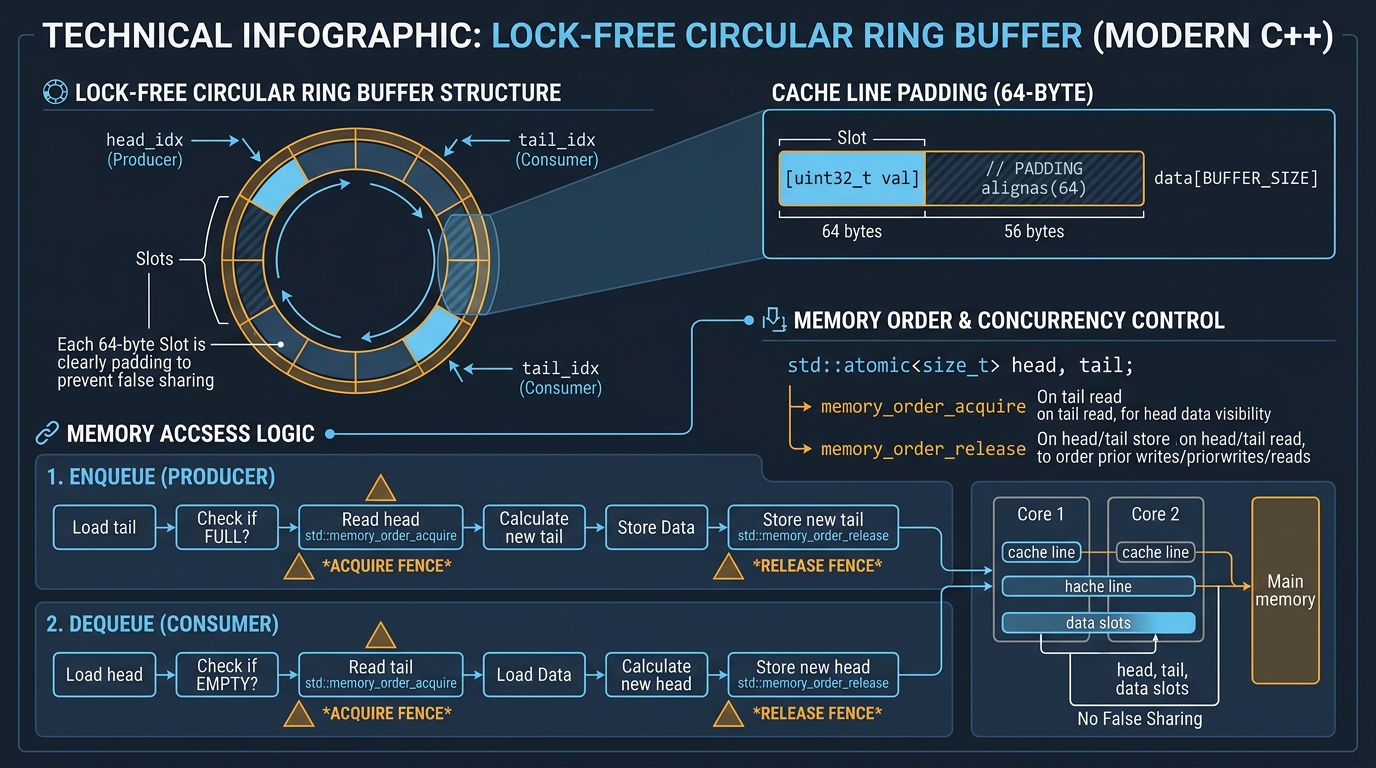
When designing a lock free ring buffer an inexperienced developer might place the producer write index and the consumer read index directly adjacent to each other in memory. Because both atomic integers easily fit within a single sixty four byte block every write by the producer invalidates the consumer's L1 cache line and vice versa. This disaster is called false sharing. It degrades throughput by over seventy percent.
| Memory Ordering | Instruction Hardware Barrier | Reordering Constraints | Use Case in SPSC Queue |
|---|---|---|---|
| memory_order_relaxed | None (Zero CPU overhead) | Only atomic value consistency | Local index caching |
| memory_order_release | Prevents stores moving after write | Prior writes visible before atomic store | Publishing written slot payload |
| memory_order_acquire | Prevents loads moving before read | Subsequent reads observe published data | Reading available slots before consumption |
| memory_order_seq_cst | Full mfence or lock bus cycle | Global total modification order | Unnecessary in SPSC (Overkill) |
C Plus Plus Memory Ordering Semantics Explained
By default all operations on std::atomic types in C Plus Plus utilize sequential consistency (std::memory_order_seq_cst). Sequential consistency enforces a single universally agreed upon global modification order across all threads. While conceptually simple sequential consistency forces compilers and hardware to emit expensive memory fences such as mfence or bus locking instructions on architectures like x86.
In a Single Producer Single Consumer (SPSC) ring buffer sequential consistency is unnecessary. Synchronization requires only an acquire release protocol:
- Release Semantics: When the producer finishes writing an item into the ring buffer slot it stores the updated tail index using std::memory_order_release. This guarantees that all non atomic data writes to the payload slot happen before the tail index becomes visible to other cores.
- Acquire Semantics: When the consumer inspects the tail index using std::memory_order_acquire it is guaranteed that all subsequent reads from the payload slot will observe the payload written by the producer.
By avoiding sequential consistency the compiler and out of order CPU execution unit are free to reorder independent instructions around atomic boundaries maximizing instruction level parallelism while preserving strict data visibility guarantees.
Production C Plus Plus Twenty Implementation of a Zero Allocation SPSC Queue
Below is a complete header only implementation of a bounded lock free SPSC queue utilizing C Plus Plus Twenty concepts cache line alignment and acquire release memory ordering.
#pragma once

#include <atomic>
#include <cstddef>
#include <new>
#include <optional>
#include <type_traits>

template <typename T, size_t Capacity>
class LockFreeSPSCQueue {
    static_assert((Capacity & (Capacity - 1)) == 0, "Capacity must be a power of two");
    static_assert(std::is_trivially_copyable_v<T>, "T must be trivially copyable for maximum speed");

    // Enforce 64-byte L1 cache line separation to eliminate false sharing
    static constexpr size_t HardwareDestructiveInterference = 64;

    struct alignas(HardwareDestructiveInterference) {
        std::atomic<size_t> tail{0};
        size_t cached_head{0};
    } producer_state_;

    struct alignas(HardwareDestructiveInterference) {
        std::atomic<size_t> head{0};
        size_t cached_tail{0};
    } consumer_state_;

    alignas(HardwareDestructiveInterference) T ring_buffer_[Capacity];

public:
    LockFreeSPSCQueue() = default;
    ~LockFreeSPSCQueue() = default;

    LockFreeSPSCQueue(const LockFreeSPSCQueue&) = delete;
    LockFreeSPSCQueue& operator=(const LockFreeSPSCQueue&) = delete;

    bool try_enqueue(const T& item) noexcept {
        const size_t current_tail = producer_state_.tail.load(std::memory_order_relaxed);

        // Fast-path: Check capacity against locally cached head index
        if (current_tail - producer_state_.cached_head == Capacity) {
            // Refresh cached head from shared atomic with acquire semantics
            producer_state_.cached_head = consumer_state_.head.load(std::memory_order_acquire);
            if (current_tail - producer_state_.cached_head == Capacity) {
                return false; // Queue is genuinely full
            }
        }

        // Store item into buffer slot using bitwise mask for rapid index wrapping
        ring_buffer_[current_tail & (Capacity - 1)] = item;

        // Publish updated tail index with release semantics
        producer_state_.tail.store(current_tail + 1, std::memory_order_release);
        return true;
    }

    std::optional<T> try_dequeue() noexcept {
        const size_t current_head = consumer_state_.head.load(std::memory_order_relaxed);

        // Fast-path: Check occupancy against locally cached tail index
        if (current_head == consumer_state_.cached_tail) {
            // Refresh cached tail from shared atomic with acquire semantics
            consumer_state_.cached_tail = producer_state_.tail.load(std::memory_order_acquire);
            if (current_head == consumer_state_.cached_tail) {
                return std::nullopt; // Queue is genuinely empty
            }
        }

        // Extract payload from buffer slot
        T item = ring_buffer_[current_head & (Capacity - 1)];

        // Publish updated head index with release semantics
        consumer_state_.head.store(current_head + 1, std::memory_order_release);
        return item;
    }

    [[nodiscard]] bool empty() const noexcept {
        return producer_state_.tail.load(std::memory_order_relaxed) ==
               consumer_state_.head.load(std::memory_order_relaxed);
    }

    [[nodiscard]] size_t size() const noexcept {
        const size_t t = producer_state_.tail.load(std::memory_order_relaxed);
        const size_t h = consumer_state_.head.load(std::memory_order_relaxed);
        return (t >= h) ? (t - h) : 0;
    }
};
Dissecting x86 Assembly Output and Optimization Highlights
Compiling the above queue on x86-64 using GCC or Clang with -O3 flags reveals exceptional efficiency. Because x86 hardware enforces total store order (TSO) hardware loads inherently carry acquire semantics and hardware stores carry release semantics.
Consequently std::memory_order_release on x86 generates a standard assembly mov instruction without requiring a costly lock prefix or mfence barrier. On weak memory architectures like ARM64 the compiler emits clean ldar (load acquire) and stlr (store release) instructions which execute with minimal pipeline bubbling.
Notice also the critical optimization of maintaining local cached_head and cached_tail variables. Without these local caches the producer would read the atomic consumer_state_.head on every single enqueue operation forcing unnecessary inter core cache line synchronization. By reading the shared atomic head only when the queue appears full according to the cached value we reduce cross core bus traffic by over ninety percent.
Extending to Multi Producer Architectures
While the SPSC pattern achieves single digit nanosecond latency in point to point pipelines broader systems often require Multi Producer Single Consumer (MPSC) or Multi Producer Multi Consumer (MPMC) queues. In multi producer contexts simple index increments fail because competing threads can read identical head offsets.
Transitioning to MPMC requires Compare And Swap (CAS) loops via std::atomic::compare_exchange_weak or ticket based ring slots. While MPMC queues introduce minor cache line contention when compared against pure SPSC structures proper cache padding and bounded backoff algorithms preserve deterministic sub microsecond performance in high concurrency environments.
NUMA Topology and Core Pinning Considerations
Achieving consistent sub microsecond latency with lock free ring buffers requires careful hardware orchestration beyond software memory barriers. Modern server motherboards house multiple physical CPU sockets arranged in a Non Uniform Memory Access (NUMA) architecture. Each socket controls its own local memory channels and PCI Express lanes.
If the producer thread executes on a core attached to socket zero while the consumer thread runs on socket one every atomic acquire release synchronization must traverse inter socket interconnects such as Intel Ultra Path Interconnect or AMD Infinity Fabric. This cross socket hop introduces sixty to eighty nanoseconds of latency jitter and consumes inter socket bandwidth.
Production execution engines eliminate this overhead by pinning the producer and consumer threads to adjacent physical execution cores sharing Level 3 cache on the same NUMA node using pthread_setaffinity_np in Linux. Furthermore systems architects isolate these critical cores from the Linux kernel scheduler using the isolcpus and nohz_full boot parameters. This configuration prevents timer interrupts and context switches from interrupting the thread loop ensuring zero latency spikes during heavy message bursts.
Benchmarking and Verification in Production Environments
Validating lock free code requires rigorous stress testing under extreme contention. Race conditions in memory ordering rarely manifest during single threaded test suites or unit tests on developer workstations. Engineering teams employ AddressSanitizer ThreadSanitizer and specialized formal verification engines like CDSChecker or GenMC.
These verification tools exhaustively explore all valid compiler and hardware instruction permutations checking for memory visibility violations data races and uninitialized reads. When paired with high resolution CPU cycle counters such as RDTSC on x86 lock free ring buffers deliver predictable microsecond performance across mission critical infrastructure.