The Decay of Traditional Market Price Signals
Quantitative hedge funds face continuous alpha decay as traditional price and volume signals become widely known. When hundreds of systematic strategies trade identical technical indicators market efficiency increases and profit margins compress. To maintain strong returns top research teams search for alternative datasets that capture economic reality before price adjustments occur.
Core Categories of Alternative Financial Datasets
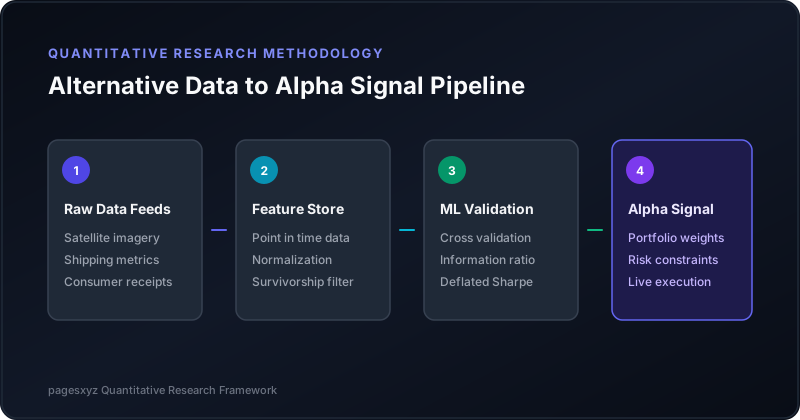
Alternative data spans several distinct categories. Consumer transaction logs reveal daily retail spending patterns weeks before quarterly corporate earnings reports. Satellite imagery tracks shipping container movements around global ports and parking lot density outside major department stores. Financial natural language processing scans regulatory filings trade press and social sentiment to identify emerging operational risks.
Building Resilient Point in Time Feature Pipelines
Extracting raw data is only the initial hurdle. The most critical stage in alternative data research is point in time alignment. Many data vendors update historical databases retrospectively with revised figures. If a researcher trains an algorithm on restated historical data the model develops lookahead bias that fails completely in real trading.
Feature stores must preserve the exact timestamp when each piece of information became publicly available. Outliers survivorship bias and missing data intervals must be corrected before model training starts. Without rigorous normalization even the most sophisticated neural network will learn spurious noise.
Machine Learning Architectures for Signal Extraction
Modern research teams employ gradient boosted decision trees and deep learning architectures to process high dimensional feature vectors. Transformers and recurrent units excel at capturing sequential dependencies across unstructured textual disclosures. Graph neural networks model supply chain interdependencies between suppliers and manufacturers.
Strict Validation and Out of Sample Verification
Validation requires strict discipline. Researchers use purged cross validation to prevent information leakage between adjacent trading days. Metrics like deflated Sharpe ratio and out of sample information coefficient help distinguish genuine statistical edge from statistical overfit.
Live Portfolio Integration and Execution Considerations
A profitable signal must survive transaction costs and market impact. Signals derived from alternative data often trade at medium frequencies with holding horizons ranging from several days to several weeks. Firms that combine high quality feature pipelines with robust risk models capture sustainable profits in modern markets.