The Challenge of Large Institutional Order Execution
Executing large institutional orders without moving market prices is one of the most difficult challenges in quantitative finance. When an asset manager needs to purchase ten million shares of a liquid stock dumping the full size into the market triggers immediate price slippage. Other market participants detect the aggressive order flow and push prices higher before the order fills.
Why Rule Based TWAP and VWAP Strategies Fall Short
Standard algorithmic execution strategies like time weighted average price and volume weighted average price follow rigid schedules. A simple time based algorithm slices a large parent order into small child orders at fixed intervals. Predatory market participants exploit these predictable schedules by front running anticipated liquidity demands.
Formulating Trade Execution as a Reinforcement Learning Problem
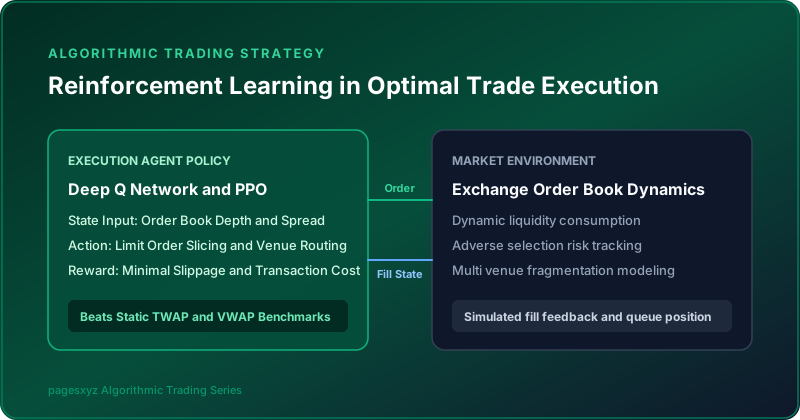
Reinforcement learning offers a dynamic solution by treating execution as a sequential decision process. An artificial intelligence agent observes the current state of the limit order book and chooses optimal actions. The agent observes bid ask spread width queue depth order book imbalance and recent trade velocity across multiple market venues.
Passive Posting versus Aggressive Spread Crossing
The agent action space involves choosing when to post passive limit orders and when to cross the spread with aggressive market orders. Passive orders capture exchange maker rebates and avoid paying the half spread. However passive orders face execution risk if the market trends away before getting filled.
Reward Engineering and Adverse Selection Penalties
Designing an effective reward function is the core of reinforcement learning in trading. A simple reward based only on final fill price can encourage risky behaviors like delaying execution until the end of the trading day. Production systems incorporate penalty terms for inventory variance execution delay and adverse selection.
Multi Venue Liquidity Routing and Production Controls
Deploying reinforcement learning models into live production requires conservative safeguards. Trading desks run execution policies inside strict risk containers with hard limits on maximum participation rates and instantaneous slippage. Under proper risk controls reinforcement learning algorithms consistently beat standard static execution benchmarks.