The Modern Latency Race in Electronic Markets
Electronic financial markets operate at sub microsecond time scales where every single clock cycle counts. Proprietary trading firms and electronic market makers historically relied on C Plus Plus for writing matching engines exchange gateways and pricing infrastructure. Over the past few years Rust has emerged as a serious challenger.
Why C Plus Plus Dominated Two Decades of Trading Infrastructure
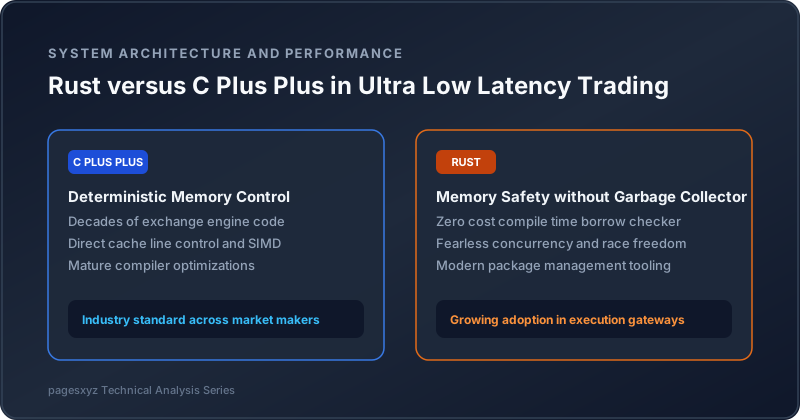
C Plus Plus offers bare metal performance and complete control over system memory layout. Developers can align data structures directly with CPU cache lines. They can eliminate heap allocations entirely inside hot execution loops. Modern C Plus Plus standards like C Plus Plus 20 and C Plus Plus 23 introduce concepts and modules that enhance code quality.
The Pitch for Rust Memory Safety Without Latency Penalties
The primary challenge with C Plus Plus remains undefined behavior. Memory corruption bugs such as use after free and buffer overflows can remain hidden during development. In high frequency trading an undetected memory bug during live market volatility can result in catastrophic financial losses.
Rust addresses this vulnerability through its compile time ownership model and borrow checker. The compiler enforces thread safety and memory safety guarantees without introducing a garbage collection runtime. This makes Rust uniquely suited for deterministic latency profiles.
Tail Latency and Cache Locality Benchmarks
Tail latency is the true test for any algorithmic trading engine. An engine that averages fifty nanoseconds per message but spikes to ten microseconds during packet bursts will miss critical market fills. Rust zero cost abstractions generate assembly that matches optimized C Plus Plus code in tight loops. Cache line alignment and SIMD vectorization work reliably in both languages.
Practical Trade Offs in Exchange Connectivity
Adopting Rust across an established market maker involves practical engineering trade offs. Major exchanges like CME and Nasdaq provide native client connectivity libraries written in C and C Plus Plus. Integrating Rust with legacy C APIs requires foreign function interface wrappers that require careful maintenance.
Where Trading Firms Are Deploying Rust Today
Today leading trading desks adopt a hybrid architecture. Core feed handlers and existing network cards often remain in C Plus Plus. Meanwhile new execution gateways risk engines and crypto liquidity routers are frequently built from scratch in Rust. Software engineers entering the quantitative trading industry benefit greatly from mastering both languages.