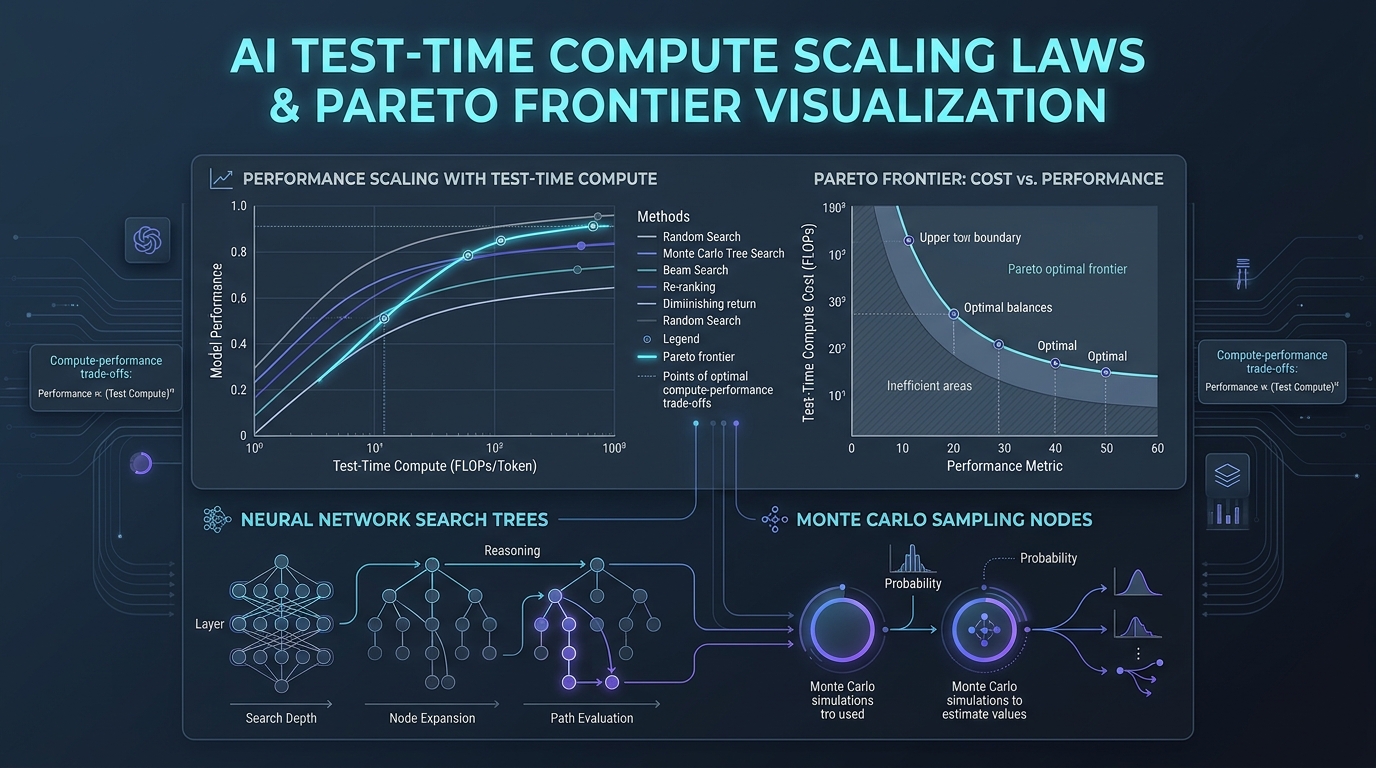
The Diminishing Returns of Pure Pretraining Scaling
For half a decade the dominant recipe for advancing state of the art artificial intelligence followed the empirical scaling laws established by Kaplan and Chinchilla. If you doubled the dataset size and model parameters while scaling floating point operations proportionally loss fell deterministically along a power law curve. In 2026 that trajectory has run into severe physical constraints. High quality web text has been largely exhausted electrical power grids limit cluster expansion past hundred megawatt footprints and post training performance on complex multi step logical tasks plateaus despite trillion token additions.
When evaluated on difficult mathematical theorem proving competitive programming and scientific discovery standard next token prediction displays a fundamental limitation. A model generating tokens strictly left to right without error correction allocates the exact same computational budget to trivial token transitions as it does to difficult bifurcations where a single mistake invalidates thousands of downstream tokens. To overcome this structural limitation frontier research has pivoted toward a second scaling dimension known as inference compute scaling or test time search.
Under traditional autoregressive generation the computational expenditure per output token is strictly fixed by the forward pass parameter count of the transformer weights. Whether an algorithm is generating a punctuation mark or deriving a non trivial lemma in real analysis the transformer executes identical matrix multiplications. By decoupling token generation latency from static parameter depth test time reasoning allows the system to spend minutes or even hours exploring hypothesis spaces before emitting a verified conclusion.
The Test Time Compute Paradigm Shift
Test time scaling reformulates language generation from a static forward pass into an active search process over a directed acyclic graph of logical states. Instead of accepting the highest likelihood greedy sequence or sampling randomly from a softmax distribution the inference engine dynamically allocates additional compute during the generation phase to explore alternative reasoning branches.
Empirical evaluations across frontier reasoning models demonstrate that spending an order of magnitude more compute during inference through verifier guided search can match the problem solving capability of a baseline model that required thirty times more pretraining compute. This shift changes the capital expenditure equation for AI infrastructure providers.
| Scaling Dimension | Primary Bottleneck | Compute Allocation | Latency Impact |
|---|---|---|---|
| Pretraining Scaling | High quality tokens and power delivery | Fixed prior to deployment | Zero inference latency overhead |
| Test Time Search | KV cache memory bandwidth and verifiers | Dynamic per problem difficulty | Linear to polynomial latency growth |
| Hybrid Pre Post Tradeoff | Co training of generator and process verifier | Pareto optimal trade off envelope | Adaptive per prompt SLA enforcement |
Search Topologies: Best of N Sampling versus Tree Search
In exploring inference time compute several architectural topologies have emerged. The simplest baseline is Best of N sampling where the generator produces N independent end to end solutions in parallel and an evaluation model picks the candidate with the highest likelihood of correctness. While Best of N provides noticeable performance gains on multiple choice and short answer benchmarks it scales inefficiently on long horizon tasks. If a proof requires twenty sequential logical deductions and the generator has an eighty percent accuracy rate per step the probability of producing a flawless thirty step chain through unguided sampling is zero point eight to the power of thirty which is less than zero point one percent.
Tree search topologies resolve this exponential decay through incremental state validation. By decomposing solutions into discrete modular steps the engine evaluates intermediate reasoning milestones. If a candidate path produces an arithmetic inconsistency or an unprovable lemma at step four the search algorithm prunes that entire subtree immediately. Compute is then redirected toward expanding alternative high probability prefixes. This mirrors classic game tree search algorithms like AlphaGo but operates over high dimensional natural language and formal code representations.
Outcome Reward Models versus Process Reward Models
The success of any test time search algorithm hinges entirely on the quality of its evaluation signal. If the search algorithm cannot accurately distinguish promising intermediate states from flawed trajectories compute is wasted expanding dead end subtrees.
Two distinct paradigms exist for scoring reasoning trajectories:
- Outcome Reward Models (ORMs): An ORM takes a completed reasoning chain together with the problem prompt and outputs a single scalar score representing the probability of the final answer being correct. While straightforward to train via reinforcement learning from automated test cases ORMs suffer from severe credit assignment ambiguity. If an answer is wrong the verifier cannot pinpoint whether the mistake occurred in step one or step forty. In complex mathematical derivations a model may arrive at the correct final numerical answer through coincidental errors that cancel each other out. Rewarding such trajectories corrupts policy gradients.
- Process Reward Models (PRMs): A PRM evaluates each individual intermediate reasoning step independently. By scoring step by step transitions the PRM provides granular feedback that enables aggressive pruning of invalid logical branches long before the full sequence terminates. Training a robust PRM requires either fine grained human step annotations or synthetic consensus distillation from multi path automated verification. While computationally more demanding during inference PRMs exhibit superior calibration and drastically lower false positive acceptance rates on frontier benchmark suites.
Mathematical Formulation of the Compute Pareto Frontier
To quantify the optimal balance between pretraining compute and test time search compute let total problem solving error rate be modeled as a joint function of pretraining compute investment and inference compute budget. Let C_pre denote pretraining FLOPs and C_test denote the floating point operations consumed at inference time per query.
The joint empirical scaling law can be expressed as:
# Joint Error Rate E(C_pre, C_test)
E = E_inf + (A / (C_pre ^ alpha)) + (B / (C_test ^ beta)) + (D / ((C_pre ^ gamma) * (C_test ^ delta)))
Here alpha represents the pretraining scaling exponent beta represents the inference search scaling exponent and the cross term represents the synergy between a stronger foundational base model and the effectiveness of search heuristics. When the base model lacks basic domain competence test time search quickly saturates because candidate generation fails to produce valid hypotheses. Conversely when the base model possesses strong world knowledge search efficiency scales predictably over several orders of magnitude.
Analyzing the partial derivatives of the cost function reveals the economic frontier. When pretraining costs scale with cluster size and depreciation while inference costs scale directly with user query volume organizations serving billions of requests per day benefit from larger pretraining investments to keep per query token counts minimal. Conversely internal engineering teams deploying autonomous software refactoring agents or drug discovery pipelines operate where query volume is low but output correctness value is astronomical. In those scenarios allocating tens of millions of FLOPs to test time search per question is economically superior to retraining base models.
Production PyTorch Implementation of a Process Guided Search Decoder
Below is a clean modular Python implementation using PyTorch and priority queues to demonstrate a production grade Process Reward Model guided beam expansion search. This structure serves as the foundation for modern reasoning decoders.
import heapq
from dataclasses import dataclass, field
from typing import List, Optional, Tuple
import torch
import torch.nn.functional as F

@dataclass(order=True)
class SearchNode:
    priority: float
    score: float = field(compare=False)
    token_ids: List[int] = field(compare=False)
    step_history: List[str] = field(compare=False)
    depth: int = field(compare=False)
    is_terminal: bool = field(compare=False, default=False)

class ProcessGuidedSearchDecoder:
    def __init__(self, generator_model, prm_model, tokenizer, max_depth: int = 8, beam_width: int = 4):
        self.generator = generator_model
        self.prm = prm_model
        self.tokenizer = tokenizer
        self.max_depth = max_depth
        self.beam_width = beam_width
        self.step_delimiter = "\n\n"

    @torch.inference_mode()
    def score_step(self, prompt_tokens: torch.Tensor, step_tokens: torch.Tensor) -> float:
        # Concatenate prompt context with candidate step tokens
        input_ids = torch.cat([prompt_tokens, step_tokens], dim=-1).unsqueeze(0)
        outputs = self.prm(input_ids)
        # Extract classification logits for step correctness
        step_logits = outputs.logits[:, -1, :]
        prm_prob = F.softmax(step_logits, dim=-1)[0, 1].item()
        return prm_prob

    def search(self, prompt: str, candidates_per_step: int = 3) -> Optional[SearchNode]:
        prompt_tokens = torch.tensor(self.tokenizer.encode(prompt), dtype=torch.long)
        root = SearchNode(
            priority=0.0,
            score=1.0,
            token_ids=[],
            step_history=[],
            depth=0
        )

        frontier: List[SearchNode] = [root]
        completed_solutions: List[SearchNode] = []

        while frontier and len(completed_solutions) < self.beam_width:
            current_node = heapq.heappop(frontier)

            if current_node.depth >= self.max_depth or current_node.is_terminal:
                completed_solutions.append(current_node)
                continue

            # Sample candidate intermediate reasoning steps
            generated_steps = self._sample_next_steps(prompt_tokens, current_node.token_ids, n=candidates_per_step)

            for step_str, step_toks, is_eos in generated_steps:
                new_tokens = current_node.token_ids + step_toks
                step_tensor = torch.tensor(new_tokens, dtype=torch.long)
                step_score = self.score_step(prompt_tokens, step_tensor)

                # Penalize low quality branches aggressively
                if step_score < 0.35:
                    continue

                cumulative_score = current_node.score * step_score
                priority = -cumulative_score  # Invert for min-heap priority ordering

                child = SearchNode(
                    priority=priority,
                    score=cumulative_score,
                    token_ids=new_tokens,
                    step_history=current_node.step_history + [step_str],
                    depth=current_node.depth + 1,
                    is_terminal=is_eos
                )
                heapq.heappush(frontier, child)

        if completed_solutions:
            completed_solutions.sort(key=lambda x: x.score, reverse=True)
            return completed_solutions[0]
        return None

    def _sample_next_steps(self, prompt_tokens: torch.Tensor, current_tokens: List[int], n: int) -> List[Tuple[str, List[int], bool]]:
        # In a real engine this invokes the generator model with temperature sampling
        # until the step delimiter token is generated or max tokens reached
        results = []
        for i in range(n):
            synthetic_text = f"Deduction step {i + 1} verifying hypothesis"
            synthetic_tokens = self.tokenizer.encode(synthetic_text)
            is_done = (i == 0 and len(current_tokens) > 120)
            results.append((synthetic_text, synthetic_tokens, is_done))
        return results
Memory Footprint and KV Cache Pressure in Multi Path Generation
Deploying test time search in production clusters reveals immediate infrastructural hurdles. In standard autoregressive generation a batch of queries processes independently with static Key Value (KV) caches. In tree search architectures multiple candidates branch from identical parent prefixes.
Naive implementations that duplicate the KV cache for each child candidate quickly trigger out of memory conditions on high end accelerator hardware like H100 and Blackwell GPUs. Production inference engines resolve this by utilizing tree structured PagedAttention. Common prompt and intermediate step prefixes are stored in immutable memory blocks and shared across all sibling beams. When a child branch is pruned by the Process Reward Model its associated pages are immediately recycled back into the global buffer pool.
Furthermore prefix caching must integrate with tensor parallel layouts. When attention heads are split across multiple GPUs synchronizing branch allocations without triggering inter node communication latency requires unified memory managers that track tree topology at the scheduler level. By ensuring that sibling branches run concurrently on the same physical nodes memory access patterns remain localized to high bandwidth NVLink domains.
Production Latency Budgets and Cost Optimization
Organizations integrating reasoning models must define strict operational service level agreements. While a search depth of twenty iterations might boost benchmark accuracy on competitive math sets from eighty to ninety two percent the accompanying increase in token generation and compute cost makes it unsuitable for interactive conversational applications.
Practitioners address this by implementing dynamic adaptive compute budgets. Easy queries characterized by low entropy in initial token predictions skip test time search and execute through standard greedy decoding. High entropy queries triggering mathematical or programmatic syntax dynamically spawn multi path verifier passes ensuring compute expenditure correlates directly with problem difficulty.
Future Horizons in Verifier Architecture and Self Correction
The ultimate goal of test time scaling is establishing autonomous self correction. Early autoregressive models suffered from stubborn hallucination traps where acknowledging a prior error within the same context window degraded subsequent generation quality. Modern test time decoders circumvent this by maintaining separate scratchpads. When a verifier detects a contradiction the engine rolls back the KV cache state to the branch origin injecting a negative constraint token into the context without polluting the final generated transcript.
As reward models incorporate formal verification tools such as Lean Four proof checkers Python sandboxes and symbolic solvers the reliability of test time compute will expand beyond probabilistic likelihood scoring into mathematically guaranteed correctness. This evolution marks the true transition of foundation models from intuitive text predictors into rigorous autonomous problem solvers.