Quantitative finance is often discussed as a single homogeneous field, but the day-to-day experience varies dramatically depending on your specific job title. The three core disciplines are Quant Researcher, Quant Developer, and Quant Trader.
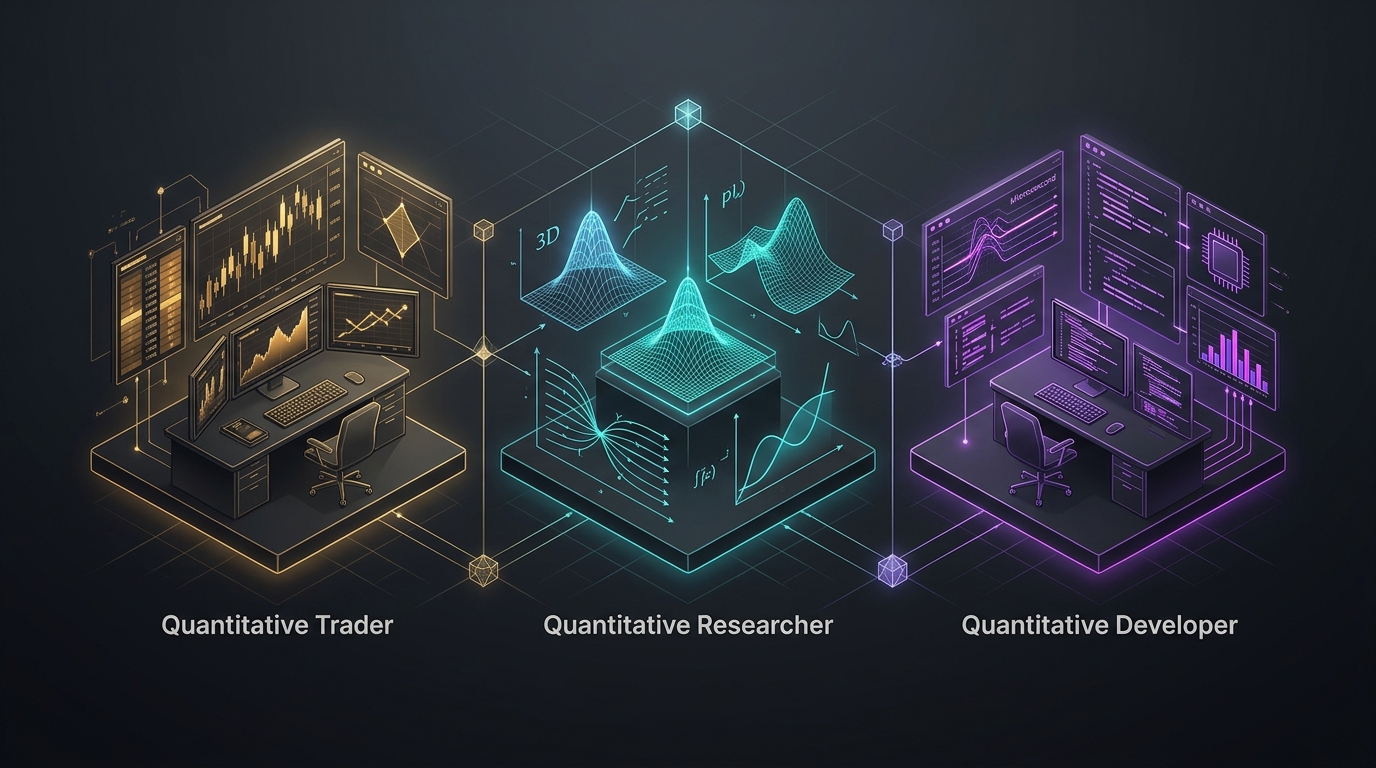
Each track attracts distinct personalities, tests different problem-solving abilities, and rewards performance through different compensation structures.
1. The Quantitative Researcher (QR)
The researcher is the scientist of the trading desk. Their primary mission is finding repeatable statistical patterns in market data and translating those patterns into profitable mathematical models.
- Typical day: Reading academic papers, cleaning messy datasets, building predictive features, writing backtests, and analyzing why a model failed during a particular market volatility regime.
- Key skills: Advanced probability, linear algebra, time-series econometrics, machine learning, and disciplined experimental methodology.
- Personality fit: Highly analytical, patient, comfortable with rejection. You must enjoy spending weeks testing an idea that ultimately turns out to have zero predictive power.
- Common background: PhD or Master's degrees in Mathematics, Physics, Computer Science, or Statistics.
2. The Quantitative Developer (QD)
The developer is the architect and builder of the desk. Without robust engineering, even the most sophisticated mathematical model cannot trade safely or profitably.
- Typical day: Optimizing order routing software, writing low-latency market data parsers, debugging network protocol bottlenecks, and maintaining high-throughput historical databases.
- Key skills: Modern C++, system architecture, multithreading, computer memory layout, network protocols, and distributed computing.
- Personality fit: Detail-obsessed craftsman. You care deeply about system reliability, edge cases, deterministic execution, and code elegance.
- Common background: Bachelor's or Master's degrees in Computer Science, Computer Engineering, or Electrical Engineering.
3. The Quantitative Trader (QT)
The trader is the pilot who sits at the controls during active market hours. While algorithms make thousands of automated decisions per minute, traders oversee the macro parameters, manage desk risk, and capitalize on unexpected market events.
- Typical day: Reviewing overnight news, monitoring live positions, adjusting risk limits, calibrating pricing parameters, and executing manual hedges when volatility spikes.
- Key skills: Fast mental math, game theory, deep market structure knowledge, and high emotional resilience under pressure.
- Personality fit: Competitive, decisive, and calm in chaotic environments. You must make fast decisions with incomplete information without freezing.
- Common background: Competitive gaming champions, poker players, and STEM graduates with strong probabilistic intuition.
Compensation and career trajectories
All three roles offer strong base salaries, but bonus mechanics differ:
- Quant Traders usually have the most direct link between personal desk P&L and bonus payouts, creating very high upside but also higher career volatility.
- Quant Researchers earn bonuses tied to the performance of their models over longer measurement windows, often with formulaic profit shares.
- Quant Developers receive competitive base salaries paired with company performance pools, offering greater stability and strong compensation growth over time.