The Complexity of Multi Strike Derivatives Books
Options market making is vastly more complex than trading underlying equities. A single equity or index can feature hundreds of listed put and call option contracts across multiple expiration dates and strike prices. A market maker must maintain two sided quotes on all active contracts while managing delta gamma vega and theta exposures.
Beyond the Black Scholes Flat Volatility Assumption
The classical Black Scholes pricing model assumes that asset returns follow a geometric Brownian motion with constant volatility. In real financial markets options implied volatility varies significantly across strike prices and maturities creating the well known volatility smile and skew.
Out of the money puts typically trade at higher implied volatilities due to market demand for downside catastrophe insurance. Market makers need dynamic continuous parametric models that capture this curvature across all strikes.
Parametric Surface Calibration with SABR and SVI
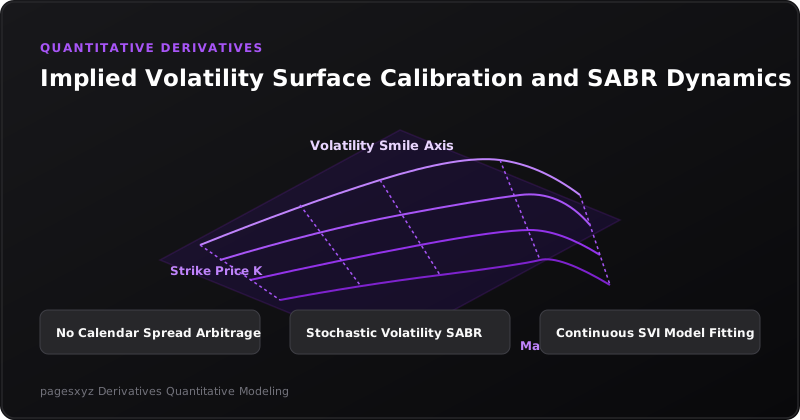
To calibrate continuous volatility surfaces quantitative desks employ specialized mathematical models like SABR stochastic volatility and Gatheral Stochastic Volatility Inspired SVI formulations.
SABR models the forward price and volatility as correlated stochastic processes providing closed form approximations for implied volatility. SVI models the total implied variance slice as a hyperbolic function of log moneyness ensuring smooth curves.
Strict No Arbitrage Enforcement
A critical requirement for automated options pricing is the absolute elimination of static arbitrage. An unconstrained mathematical curve fit can inadvertently generate calendar spread arbitrage or butterfly spread arbitrage where negative option probabilities emerge.
If a market maker publishes quotes containing butterfly arbitrage sophisticated algorithmic arbitrageurs will instantly execute risk free trades against the firm. Calibration algorithms enforce non negative risk neutral density across all evaluated strikes.
Real Time Hedging and Portfolio Risk
Once quotes fill market makers immediately hedge their underlying delta exposure by trading futures or underlying cash stocks. Residual gamma and vega risks are managed across the aggregate book through cross asset balancing and structured risk envelopes.