The Operating System Bottleneck in Modern Execution
In ultra low latency algorithmic trading every nanosecond spent inside operating system routines represents lost opportunity. Standard network programming on Linux relies on POSIX socket system calls. While these interfaces offer stability and broad hardware compatibility they introduce significant overhead during high throughput market bursts.
Understanding Kernel Traps and Context Switching
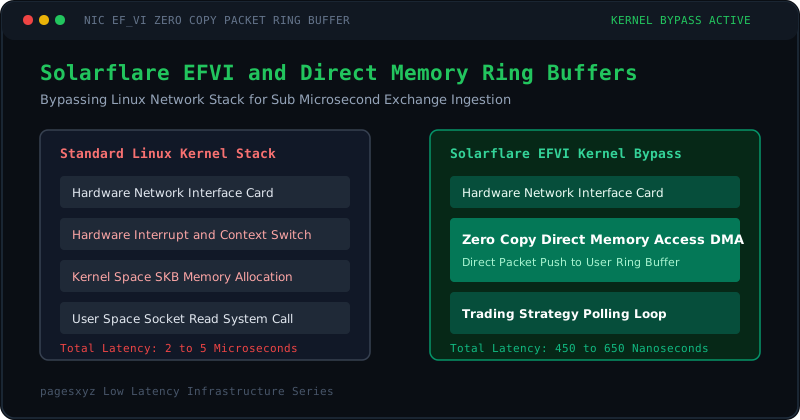
When an exchange market data packet hits a conventional network card the hardware triggers an electrical interrupt line. The CPU must immediately pause executing the active user thread save register states and switch into privileged kernel mode. The operating system kernel allocates a socket buffer structure copies payload bytes and signals the application thread through an event loop.
This context switch alone costs several microseconds. During fast market moves and economic news releases thousands of market updates flood the network interface card. The resulting interrupt storm saturates CPU cores and introduces massive latency variance across trades.
Direct Hardware Access Through Solarflare EFVI
Kernel bypass technology completely eliminates the operating system kernel from the critical network path. Solarflare network interface cards support the EFVI application programming interface. EFVI provides a lean user level interface directly to the physical network card ring buffers.
With EFVI the trading application maps packet memory buffers directly into user space memory using direct memory access DMA techniques. When an exchange multicasts a price quote update the network card hardware deposits the Ethernet frame directly into application memory without intermediate copies or operating system involvement.
Tight Polling Loops and Zero Copy Architecture
Algorithmic trading engines using EFVI execute dedicated busy polling loops pinned to isolated CPU cores. Instead of sleeping and waiting for kernel wake up notifications the core continuously inspects hardware completion event queues. The moment a packet arrives the parsing logic unpacks binary exchange protocols like ITCH or Simple Binary Encoding.
This zero copy architecture drops total packet ingestion latency from four microseconds down to under six hundred nanoseconds. The reduction in jitter allows automated market makers to cancel quotes ahead of stale fills.
Engineering Considerations and System Reliability
Developing kernel bypass applications demands disciplined systems engineering. Because the operating system is removed developers must manage ring buffer allocation packet drops and hardware timestamps manually. Despite the added complexity kernel bypass remains mandatory infrastructure across leading proprietary trading desks.