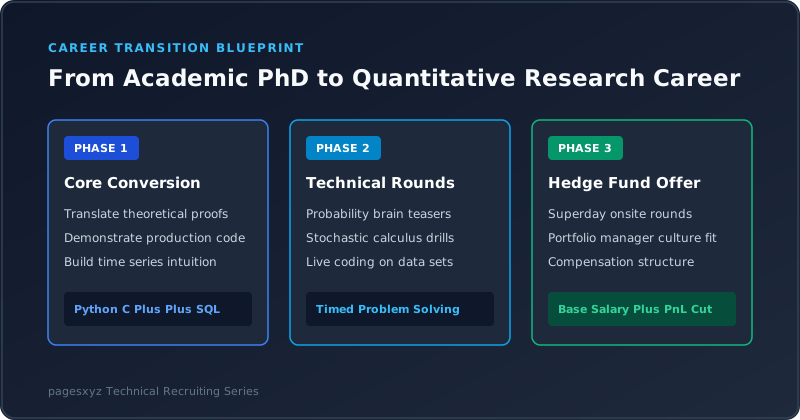
Why Trading Firms Value Academic Doctoral Training
Top quantitative hedge funds and proprietary trading shops consistently hire PhD graduates from physics mathematics computer science and electrical engineering. What makes doctoral candidates attractive is not knowledge of financial jargon but proven ability to formulate hypotheses analyze messy empirical data and solve unsolved problems under uncertainty.
Unlearning Academic Habits That Slow You Down
The primary hurdle for academic researchers entering industry is adjusting to commercial time horizons. In academic research a project may take three years to yield a publishable journal paper. In quantitative trading research cycles operate in weeks or months.
Academic perfectionism must give way to pragmatic statistical validation. A model that achieves fifty five percent directional accuracy with controlled downside risk is far more valuable than an intricate mathematical theory that cannot survive transaction costs.
Upgrading Software Engineering to Production Standards
Many academics write exploratory scripts that work only on personal workstations. In professional quantitative finance your research code must integrate with high performance data pipelines and backtesting frameworks.
Candidates must master vectorized Python libraries and demonstrate familiarity with clean C Plus Plus or Rust implementations. Writing modular testable code with Git version control and proper documentation immediately distinguishes top applicants.
Preparing for Technical Interviews and Probability Drills
Quantitative research interviews heavily evaluate foundational probability statistics and mental agility. Expect rigorous questions covering Markov chains stochastic calculus linear algebra conditioning and combinatorial puzzles under timed interview conditions.
Practice working through classic brain teasers on a whiteboard while verbalizing your reasoning clearly. Interviewers assess your thought process and response to hints just as much as the final mathematical answer.
Evaluating Offer Packages and Research Desk Culture
Compensation in quantitative finance differs fundamentally from academic salaries. Total compensation consists of a competitive base salary alongside performance bonuses tied to trading desk profitability. Finding a team with transparent mentoring and collaborative research culture ensures long term career growth.